
A distributor in Jeddah buys truck tires, brake assemblies, shock absorbers and filters, but not in the same rhythm. Tyres move in seasonal blocks; brake shoes follow fleet replacement cycles; filters are a steady consumable. Splitting those four lines into four shipments meant four freight bookings, four sets of documents and four arrivals to clear. The alternative was to build one 40HQ around the entire requirement and load it in a sequence that protects each product. This case walks through that sequence as a checklist, because the order in which you solve the problems is what decides whether the container closes cleanly.
1. Confirm the mix is physically compatible before quoting
The first check is not price, it is whether the four lines can share a box without damaging each other. Tyres are dense and awkward; brake assemblies are heavy and edge-sensitive; shock absorbers are long, oil-filled and cannot be stacked under load; filters are light but crush easily and must stay dry. A mix of dense and light cargo is actually an advantage, because the light lines fill volume that the heavy lines leave behind. The mix fails only when the heavy part is also the bulky part, and here it was not.
2. Weight first, volume second
A 40HQ gives roughly 76 m³ of internal volume and a payload ceiling that is far lower than most buyers assume. We size every line against payload before we look at floor space, then use volume as the second constraint. In practice the tires carry most of the tonnage, brake assemblies add a concentrated load over a small footprint, and the shock absorber and filter lines are treated as volume fillers with a weight check at the end. If the tire line alone approaches the payload ceiling, the honest answer is a second container, not thinner pallets.
Calculate the total as net weight plus packaging weight plus pallet weight, then add a margin for lashing timber and dunnage. The figure that goes on the packing list must be the figure the forwarder works from, not an earlier estimate.
3. Load tires standing, not lying flat
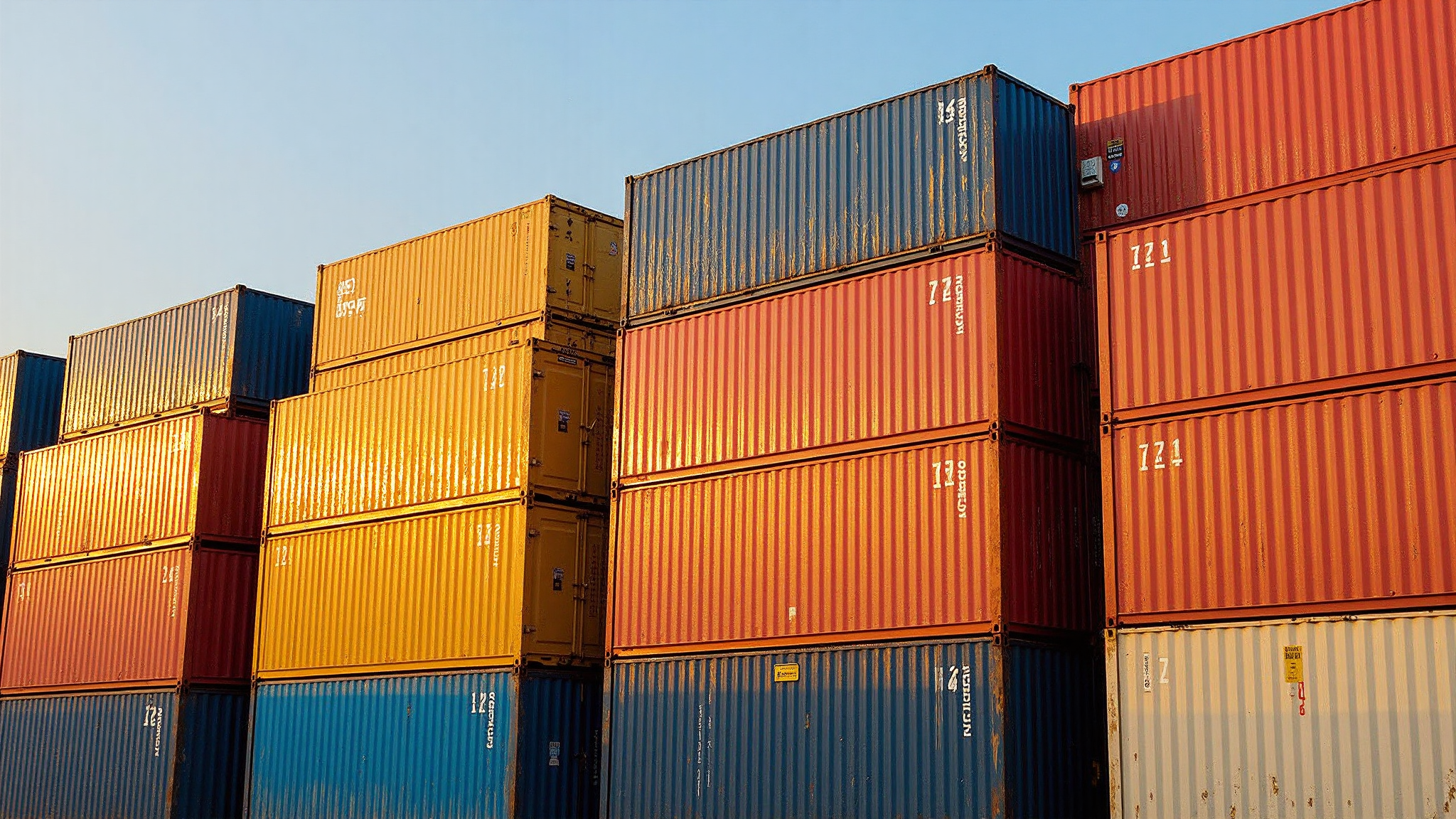
TBR and OTR casings are loaded on tread, standing upright, banded in columns and lashed to the container wall. Standing tires use the height of the box instead of the floor, which is exactly what a mixed load needs, and they avoid the sidewall deformation that comes from stacking flat under weight on a long sea leg. The loading order matters: tires go in first, from the nose forward, because they are the least compressible line and the hardest to reposition once other cargo is placed.
- Stand on tread, banded in stable columns, never leaning unsupported.
- Lash to the side rails at two heights; do not rely on friction alone.
- Leave the last bay free for palletised brake parts and cartons.
- Keep OTR casings away from the door end to avoid a top-heavy opening.
4. Palletise brake parts and put the heaviest pallet on the floor
Brake shoes and brake assemblies are packed as matched sets, wrapped, and palletised so that the friction surface is never in contact with another component. Each pallet is labelled with the set reference before it enters the container, because once it is inside, the label is the only thing the destination warehouse can read. Heavy pallets sit directly on the container floor between the tire columns, not on top of cartons. Nothing is stacked on a pallet of brake assemblies: the castings will take the load, but the boxes will not.
5. Fill the remaining volume with shock absorbers and filters
Shock absorbers travel horizontally in their cartons, bundled and braced so they cannot roll or slide along the container floor. Filters, packed in export cartons, go into the gap above and beside the palletised brake parts, with a clear note on the packing list that they are the crushable line. This is also where the load plan earns its margin: if the filter cartons do not fit, they come out, not the lashing.
6. Close the document set before the doors shut
Documents are treated as a checklist of their own, and the container is not sealed until every item is signed off. This is the part of the process that most mixed shipments get wrong, because a mixed load has more line items on the packing list than a single-product container.
- Commercial invoice, with each product line priced separately.
- Packing list showing pallet count, carton count, net and gross weight per line.
- HS codes per line, checked against what the destination broker expects.
- Tire conformity documents: GCC and SASO, with DOT marking where the specification calls for it.
- Brake line quality documents: IATF 16949 system certificate and the test report for the supplied sets.
- Certificate of origin, and ISPM 15 treatment mark on all timber packaging and dunnage.
- Shipping marks matching the pallet labels, not a generic reference.
7. Decide the declaration header before production, not after
A consolidated shipment can be declared under the factory header or under an agent header nominated by the buyer. The choice affects the invoice issuer, the certificate of origin and, in some cases, how the destination clears the tire line. It has to be settled while the order is still being produced, because changing the invoice issuer after the container leaves is not a paperwork correction, it is a re-issue with a different exporter of record.
8. What arrives at the destination
The buyer receives one bill of lading, one customs entry and one per-line packing list that maps to the pallet labels. That is the whole point of the exercise: the receiving warehouse can split the container by product line without opening every carton to find out what is inside, and the accounts department can cost each line against a single freight figure instead of apportioning four separate invoices.
Where this model fits, and where it does not
Consolidation suits a distributor or fleet supplier with multi-line demand and a warehouse that can take a mixed delivery. It does not suit a buyer optimising purely on unit price for one product, because a full container of a single line will always beat a mixed one on landed cost per unit. It also does not suit a first order that is still being validated line by line; in that case a small trial quantity of the two riskiest lines is the better first step, and the container follows once the fit is confirmed.
How a mixed order usually starts
The usual sequence is a trial quantity on one or two lines with neutral packaging, a review of the samples against the fleet or workshop requirement, and then a mixed container built around the confirmed lines. OEM branding and buyer-specified packaging are available on the brake line, and the tire line can be supplied against the certification set the destination requires. Lead time is quoted per line, and the container sails when the longest line is ready, so the production sequence is planned backwards from that date rather than forwards from the order.